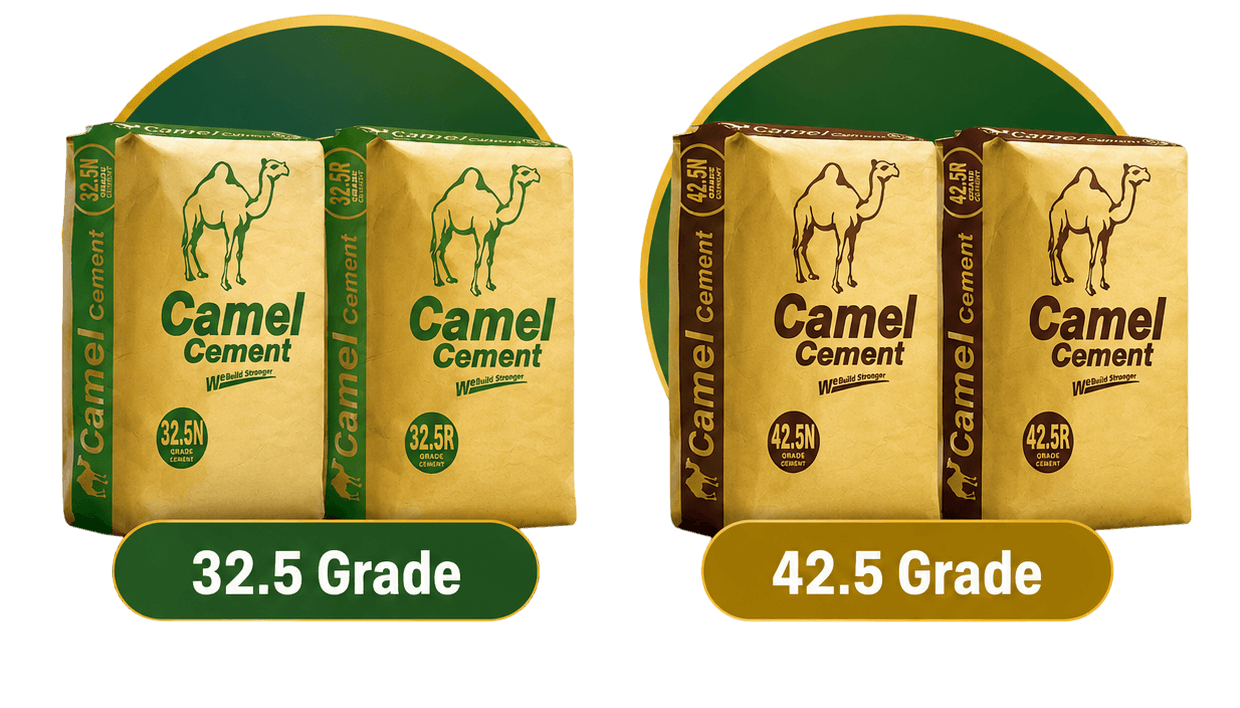
Cement bags contain more information than the brand name. Numbers such as 32.5 and 42.5, together with letters such as N and R, help identify the performance class of the cement. Understanding these markings makes it easier to compare products and discuss project requirements with engineers, contractors and suppliers.
The markings do not replace a project specification, but they provide a useful starting point.
What the numbers mean
The numbers 32.5 and 42.5 identify cement strength classes measured through standard laboratory testing. They are not the weight of the bag and they do not describe the strength of every concrete mix made with the cement.
Concrete strength depends on many factors, including:
- Cement type and quantity
- Water-cement ratio
- Aggregate quality and grading
- Mix proportions
- Admixtures
- Batching accuracy
- Mixing
- Placement
- Compaction
- Curing
- Site conditions
The cement grade tells you the performance class of the cement under defined tests. The final concrete still depends on how all materials and processes work together.
Understanding Grade 32.5
Grade 32.5 cement is commonly associated with general building, masonry and suitable non-specialised construction activities. It can provide good workability and practical performance for everyday construction when used correctly.
Typical applications may include:
- Masonry mortar
- Plastering
- Brick and block laying
- Paving
- Floor screed
- General foundations
- Site concrete
- Road stabilisation
- Repairs
Camel Cement offers two products in this class.
Camel Cement 32.5R
Grade 32.5R is positioned as an all-purpose cement. It offers consistent, durable and economical performance for foundations, columns, walls, paving slabs, plastering, bricks and mortar.
The R means it develops early strength more rapidly than a normal early strength product in the same class.
Camel Cement 32.5N
Grade 32.5N is designed for good workability, controlled heat development and durable performance in applications such as road stabilisation, site concrete, paving, masonry and floor repairs.
The N means normal early strength development.
Understanding Grade 42.5
Grade 42.5 cement is commonly selected for structural and higher-performance concrete applications. It is often used where higher strength, dense concrete, precast production or demanding construction schedules are involved.
Typical applications may include:
- Structural columns
- Beams and slabs
- Ready-mix concrete
- Precast products
- High-strength blocks
- Roads and bridges
- Commercial structures
- Infrastructure
Camel Cement offers two products in this class.
Camel Cement 42.5R
Grade 42.5R is a rapid-strength cement. It is designed for high early strength and demanding applications such as block making, ready-mix concrete, roads, bridges, roof slabs and columns.
The rapid early strength characteristic can support efficient construction cycles when the design and site process are properly controlled.
Camel Cement 42.5N
Grade 42.5N offers strong long-term strength development and versatile performance for structural concrete, pillars, slabs, walls, precast products, bricks and paving.
It is suitable when high structural performance is required without a specific rapid-hardening requirement.
What N means
N means normal early strength development.
A normal early strength cement develops early strength at the rate defined for its class. It is not a low-quality product. It simply has a different early-strength profile from an R product.
N products can be appropriate when:
- The construction schedule allows normal strength development
- Workability and handling are important
- The approved specification calls for an N product
- Rapid formwork cycling is not required
- The application is masonry, stabilisation or standard structural work, depending on grade
What R means
R means rapid early strength development.
An R product develops early strength more quickly. This can be useful when:
- Precast elements need efficient production cycles
- Blocks need early handling strength
- Construction sequencing depends on early performance
- A project specification requires rapid early strength
- Concrete work is planned around approved early-age performance targets
Rapid early strength does not remove the need for correct curing. It also does not give permission to load a structure before professional approval.
Is 42.5 always better than 32.5?
No. A higher number is not automatically better for every activity.
A plastering team may value workability and handling more than high structural strength. A road stabilisation activity may call for a product designed for that application. A structural concrete element may require a 42.5 grade based on the engineer's design.
The best product is the one that meets the application and specification.
Can different grades be mixed?
Do not casually mix different cement grades or brands in the same batch. Differences in composition, strength development and handling can make results less predictable. Follow the approved mix design and use consistent materials.
Why curing still matters
Cement reacts with water through hydration. Concrete needs suitable moisture and temperature conditions to continue developing strength.
Poor curing can lead to:
- Surface cracking
- Dusting
- Reduced durability
- Lower strength
- Increased permeability
- Poor surface quality
The cement grade cannot compensate for excessive water, weak aggregates, poor compaction or inadequate curing.
A practical comparison
Use Grade 32.5 when the approved application calls for general construction, masonry, plastering, paving, stabilisation or other suitable work.
Use Grade 42.5 when the project requires higher structural performance, ready-mix production, precast work, demanding concrete or infrastructure applications.
Choose N for normal early strength development.
Choose R when rapid early strength is required and approved for the work.
Final selection checklist
Before purchasing, confirm:
- The construction activity
- The structural specification
- The required early strength
- The correct product grade
- The quantity required
- The condition of the bags
- The storage plan
- The curing plan
Camel Cement's product range provides clear options across all four combinations: 32.5N, 32.5R, 42.5N and 42.5R. Use the product comparison tool or speak with the technical team when you need help matching the grade to the work.