Product Guidance
42.5 and 32.5 Cement Grades Explained
The numbers and letters printed on a cement bag communicate important performance information. Learn what 32.5, 42.5, N and R mean.
8 min read · 12 June 2026
Building Stronger. Together. A member of Amsons Group.
+255 788 826 188Product Guidance
Different construction activities require different cement characteristics. This guide explains how strength class, early strength development and project type can help you make a better choice.

Choosing cement can look simple until you stand in front of several bags carrying different numbers and letters. One product may be marked 32.5, another 42.5. Some include the letter N, while others include R. Each bag may look suitable for construction, but the best choice depends on what you are building, the performance required and the specification for the work.
The goal is not to choose the product with the biggest number. The goal is to choose a cement that fits the application, construction method and project requirements.
The first question should always be practical: what is the cement being used for?
Common activities include:
A cement suitable for plastering may not be the first choice for a demanding structural concrete application. A product selected for rapid early strength may be unnecessary for ordinary masonry work. Understanding the activity immediately reduces the number of suitable options.
Cement grades such as 32.5 and 42.5 refer to strength classes measured under standard testing conditions. They help construction professionals understand the expected performance category of the cement.
Grade 42.5 products are generally selected for higher-strength and more demanding concrete work. They are commonly considered for structural concrete, precast production, ready-mix concrete and infrastructure applications.
Grade 32.5 products are commonly used for general building activities such as masonry, plastering, mortar, paving, stabilisation and other suitable construction work.
The number alone does not tell the full story. The project design, concrete mix, aggregates, water, workmanship, compaction and curing all affect the final result.
The letters N and R describe early strength development.
N means normal early strength development. These products develop strength at the normal rate defined for their class.
R means rapid early strength development. These products are intended to develop early strength more quickly.
Rapid early strength can be useful when construction schedules are tight, when precast elements need efficient production cycles or when early loading requirements have been properly considered. It should not be selected simply because it sounds stronger. The application and project specification should lead the decision.
Foundation requirements vary widely. A small residential foundation and a major commercial foundation are not the same. Consider the approved structural design, soil conditions, concrete class and engineer's specification. Camel Cement Grade 32.5R may suit many general foundation applications, while higher-strength designs may call for a 42.5 grade.
These are structural elements. Product selection should follow the approved engineering design. Camel Cement Grade 42.5N offers dependable long-term structural strength, while Grade 42.5R supports applications that require strong early strength development.
Block makers need consistent materials, controlled batching and reliable curing. Grade 42.5R can support high-output block and precast production where early strength matters. Grade 32.5R can be suitable for a wide range of general block, brick and paving activities depending on the product design and process.
Workability is important in masonry and plastering. Camel Cement Grade 32.5R is positioned as an all-purpose product for plastering, mortar and brickwork. Grade 32.5N is also designed for good workability across masonry and general site applications.
Road work includes different layers and construction methods. Grade 32.5N is intended for road stabilisation and related site applications. More demanding concrete road and bridge elements may require a 42.5 product based on the engineering specification.
Ready-mix and precast producers require repeatable performance, controlled mix designs and efficient production. Camel Cement Grade 42.5R supports rapid strength applications, while Grade 42.5N provides strong long-term structural performance.
Time matters, but it must be considered correctly. A project may require formwork to be removed according to an approved programme, precast units to move through production efficiently or concrete to achieve specified early performance.
In such cases, an R product may be appropriate. For work where standard strength development is suitable, an N product may provide the right balance of performance and handling.
Never shorten curing simply because rapid-strength cement is used. Concrete still needs proper protection, moisture management and curing.
The project specification should take priority over informal advice. Engineers and project consultants may specify:
Changing the cement without professional approval may affect compliance and performance.
Even the right cement can perform poorly if it has absorbed moisture or has been stored badly.
Before use:
Ask these six questions:
These questions make product selection more disciplined and reduce guesswork.
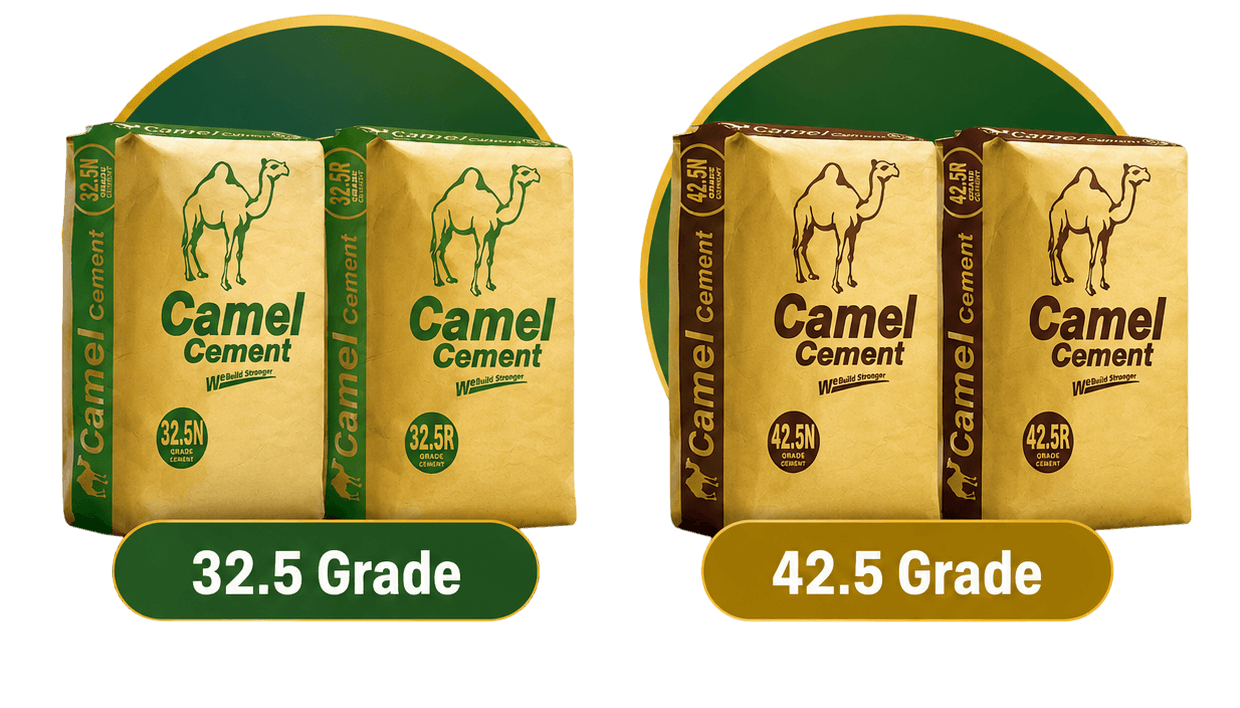
Camel Cement offers four grades for different construction needs:
Use the Camel Cement product finder to compare the range, then confirm structural requirements with the project professional. The right cement, correct mix, good workmanship and proper curing work together to create stronger construction.
Put this guidance to work on your project with Camel Cement's tools and support.
Keep Reading
Product Guidance
The numbers and letters printed on a cement bag communicate important performance information. Learn what 32.5, 42.5, N and R mean.
8 min read · 12 June 2026

Company News
Winning African Company of the Year Awards 2026 is a reflection of what Camel Cement stands for every single day: consistency, quality and trust.
2 min read · 9 July 2026